
The genesis of a visionary: From Nice to the conquest of the absolute
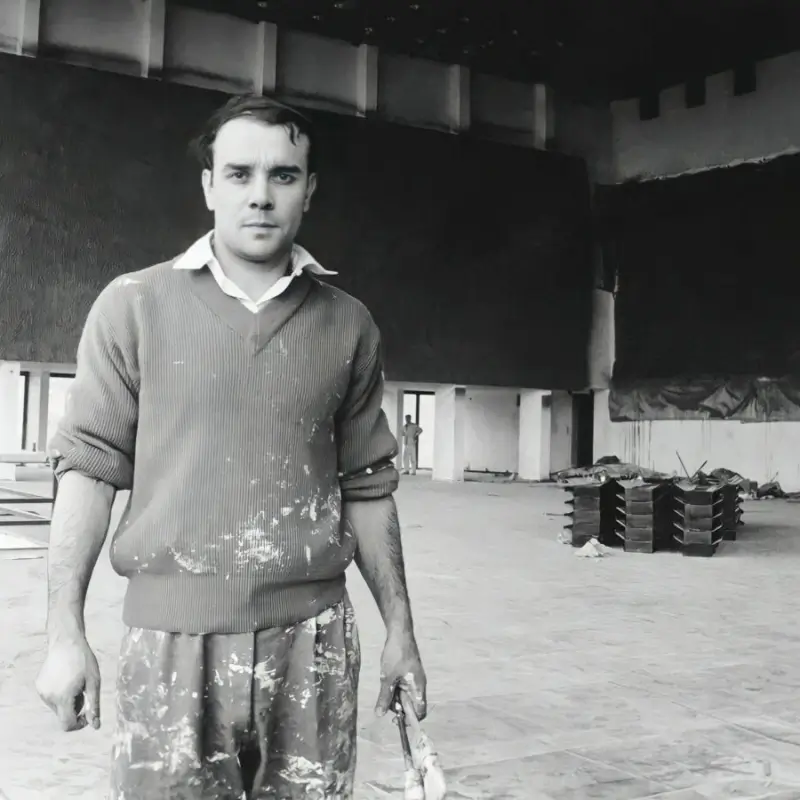
Yves Klein was born into a family of artists in Nice on 28 April 1928. His father, Fred Klein, was a figurative painter, while his mother, Marie Raymond, was a member of the lyrical abstraction movement. This artistic environment was a determining factor, even though Klein defined himself very early on as a "painter".
a break with any direct stylistic filiation.
Self-taught, Yves Klein refused academic training. In the 1940s, he became friends with Arman and Claude Pascal. Together, they developed a mythified vision of art based on the specialisation of fields: to Klein symbolically belonged the sky and infinity. This seminal period shed light on his aspiration to a non-representational art, oriented towards the absolute.
At the same time, Klein practised judo intensively. He went to Japan in the early 1950s, where he obtained a 4th dan at the Kōdōkan in Tokyo. This experience had a profound effect on his thinking:
Discipline of the body, economy of gesture, a relationship to emptiness and energy become the structuring principles of his artistic work.
From 1955 onwards, Yves Klein embarked on a radical path with monochrome painting.
For him, colour must be freed from any descriptive or symbolic function. It becomes an autonomous field of meaning, a direct experience offered to the viewer. If he experiments with several
colours, blue is rapidly establishing itself as the preferred vector for the intangible.
In 1957, he exhibited his blue monochromes, which aroused both incomprehension and fascination. To preserve the visual intensity of the pigment, he worked with a chemist to develop a special binder that gave rise to International Klein Blue (IKB), patented in 1960. This deep ultramarine blue aims to produce a sensation of pure presence, free from the materiality of the object.
Klein's thinking was not limited to painting. In 1958, he presented an exhibition in Paris entitled «La spécialisation de la sensibilité à l'état matière première en sensibilité picturale stabilisée» (The specialisation of sensibility in its raw state into stabilised pictorial sensibility), better known under the name of «Le Vide». The gallery, entirely empty, became a work in its own right. Klein asserted that art could exist without a material object, as a mental and sensitive experience.
At the end of the 1950s, Klein developed a performative dimension to his work. The Anthropometries, produced between 1958 and 1960, consisted of impressions of female bodies smeared with blue pigment, applied to canvas under the artist's direction. Klein no longer painted: he orchestrated the action, often in public, accompanied by the Symphonie Monoton-Silence. The body became a paintbrush, and the work an event.
This period also saw the emergence of his research into the immaterial, in particular the Zones of Immaterial Pictorial Sensibility, sold for gold and sometimes accompanied by symbolic rituals. Klein thus questioned the value of art, its economy and its spiritual dimension.
Despite growing international recognition, Yves Klein's career was extremely brief. He died prematurely on 6 June 1962 in Paris, aged thirty-four, following a heart attack.
Nevertheless, Yves Klein's work has had a major influence on contemporary art. Through his radical use of monochrome, his recourse to performance art, and his reflection on the void and the immaterial, he helped redefine the very limits of art and open the way to numerous conceptual and performative practices.
The genesis of a visionary: From Nice to the conquest of the absolute
Yves Klein was born into a family of artists in Nice on 28 April 1928. His father, Fred Klein, was a figurative painter, while his mother, Marie Raymond, was a member of the lyrical abstraction movement. This artistic environment was a determining factor, even though Klein defined himself very early on as a "painter".
a break with any direct stylistic filiation.
Self-taught, Yves Klein refused academic training. In the 1940s, he became friends with Arman and Claude Pascal. Together, they developed a mythified vision of art based on the specialisation of fields: to Klein symbolically belonged the sky and infinity. This seminal period shed light on his aspiration to a non-representational art, oriented towards the absolute.
At the same time, Klein practised judo intensively. He went to Japan in the early 1950s, where he obtained a 4th dan at the Kōdōkan in Tokyo. This experience had a profound effect on his thinking:
Discipline of the body, economy of gesture, a relationship to emptiness and energy become the structuring principles of his artistic work.
From 1955 onwards, Yves Klein embarked on a radical path with monochrome painting.
For him, colour must be freed from any descriptive or symbolic function. It becomes an autonomous field of meaning, a direct experience offered to the viewer. If he experiments with several
colours, blue is rapidly establishing itself as the preferred vector for the intangible.
In 1957, he exhibited his blue monochromes, which aroused both incomprehension and fascination. To preserve the visual intensity of the pigment, he worked with a chemist to develop a special binder that gave rise to International Klein Blue (IKB), patented in 1960. This deep ultramarine blue aims to produce a sensation of pure presence, free from the materiality of the object.
Klein's thinking was not limited to painting. In 1958, he presented an exhibition in Paris entitled «La spécialisation de la sensibilité à l'état matière première en sensibilité picturale stabilisée» (The specialisation of sensibility in its raw state into stabilised pictorial sensibility), better known under the name of «Le Vide». The gallery, entirely empty, became a work in its own right. Klein asserted that art could exist without a material object, as a mental and sensitive experience.
At the end of the 1950s, Klein developed a performative dimension to his work. The Anthropometries, produced between 1958 and 1960, consisted of impressions of female bodies smeared with blue pigment, applied to canvas under the artist's direction. Klein no longer painted: he orchestrated the action, often in public, accompanied by the Symphonie Monoton-Silence. The body became a paintbrush, and the work an event.
This period also saw the emergence of his research into the immaterial, in particular the Zones of Immaterial Pictorial Sensibility, sold for gold and sometimes accompanied by symbolic rituals. Klein thus questioned the value of art, its economy and its spiritual dimension.
Despite growing international recognition, Yves Klein's career was extremely brief. He died prematurely on 6 June 1962 in Paris, aged thirty-four, following a heart attack.
Nevertheless, Yves Klein's work has had a major influence on contemporary art. Through his radical use of monochrome, his recourse to performance art, and his reflection on the void and the immaterial, he helped redefine the very limits of art and open the way to numerous conceptual and performative practices.
 French
  English