
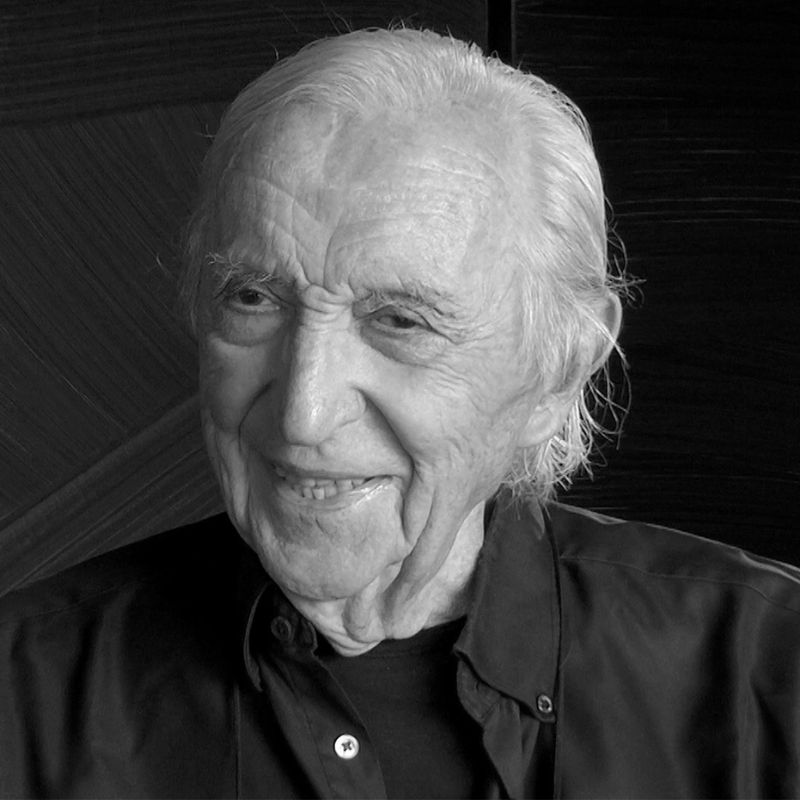
Pierre Soulages (1919 - 2022): The Master of the Outrenoir
Pierre Soulages was one of the greatest French artists of the 20th and early 21st centuries, universally recognised as the «Painter of Black». His work, characterised by a radical and obsessive exploration of the colour black, redefined our perception of light and space.
The Early Years and the Fascination for Black
Born in 1919 in Rodez, Aveyron, Pierre Soulages showed a deep interest in the arts from an early age. From an early age, the discovery of menhirs and dolmens, the rough, dark stones of his native region, and the Romanesque art of local churches, fed his imagination. At the age of 18, he went to Paris to study for the Beaux-Arts, but soon found himself at odds with academic teaching. He returned to Aveyron, preferring the self-taught exploration and introspection that would forge his singularity.
After the war, Soulages moved to Paris in 1946. It was at this time that he began to develop his distinctive style. His first works, oil paintings in dark colours, often dominated by black and brown, are characterised by broad flat tints and impastos. Black soon became the main subject of his research, rather than just another colour.
The Revelation of the Outrenoir
In 1979, a decisive moment marked his career and the history of art. While working on a canvas covered entirely in black, he was struck by the way the light reflected off the different textures and orientations of the paint. This was the birth of Outrenoir, a term he coined to describe the experience.
Outrenoir is not black as a colour, but rather «beyond black». It is a reflection on the light that emerges from black. Soulages uses a variety of techniques (striations, flat tints, scrapings, reserves) to sculpt the pictorial material of black, creating reliefs, hollows, smooth or rough surfaces. Light collides with these different textures and is reflected in a multitude of ways, producing shimmers, opacities, areas of light and shadow that reveal the depth and complexity of black itself. His works become sensors and diffusers of light.
A Universal and Timeless Language
Soulages' radical and powerful work has transcended cultural boundaries. It has been exhibited and collected all over the world, from New York to Tokyo, via numerous European capitals. He is one of the few artists to have had an exhibition in his lifetime at the Musée du Louvre (2019-2020), an exceptional tribute to his centenary.
In addition to Outrenoir, Pierre Soulages has also produced works in other media, notably etchings and lithographs, always with the same quest for light in the dark. He also designed the 104 stained glass windows in the abbey church at Conques, a monumental work in which he used a special, slightly tinted glass to filter the light and create a unique, spiritual atmosphere of light.
A Monumental Heritage
Pierre Soulages pursued his work with incredible energy and tireless curiosity until the end of his life, passing away in 2022 at the age of 102. His legacy is immense: he not only gave a new dimension to black, but also invited the public to a profound meditation on light, space and time.
The Soulages Museum in Rodez, opened in 2014, houses an exceptional collection of his work and bears witness to the artist's attachment to his native land. Pierre Soulages will go down in the history of art as the undisputed master of the Outrenoir, the artist who revealed the light hidden in the heart of darkness.
Pierre Soulages (1919 - 2022): The Master of the Outrenoir
Pierre Soulages was one of the greatest French artists of the 20th and early 21st centuries, universally recognised as the «Painter of Black». His work, characterised by a radical and obsessive exploration of the colour black, redefined our perception of light and space.
The Early Years and the Fascination for Black
Born in 1919 in Rodez, Aveyron, Pierre Soulages showed a deep interest in the arts from an early age. From an early age, the discovery of menhirs and dolmens, the rough, dark stones of his native region, and the Romanesque art of local churches, fed his imagination. At the age of 18, he went to Paris to study for the Beaux-Arts, but soon found himself at odds with academic teaching. He returned to Aveyron, preferring the self-taught exploration and introspection that would forge his singularity.
After the war, Soulages moved to Paris in 1946. It was at this time that he began to develop his distinctive style. His first works, oil paintings in dark colours, often dominated by black and brown, are characterised by broad flat tints and impastos. Black soon became the main subject of his research, rather than just another colour.
The Revelation of the Outrenoir
In 1979, a decisive moment marked his career and the history of art. While working on a canvas covered entirely in black, he was struck by the way the light reflected off the different textures and orientations of the paint. This was the birth of Outrenoir, a term he coined to describe the experience.
Outrenoir is not black as a colour, but rather «beyond black». It is a reflection on the light that emerges from black. Soulages uses a variety of techniques (striations, flat tints, scrapings, reserves) to sculpt the pictorial material of black, creating reliefs, hollows, smooth or rough surfaces. Light collides with these different textures and is reflected in a multitude of ways, producing shimmers, opacities, areas of light and shadow that reveal the depth and complexity of black itself. His works become sensors and diffusers of light.
A Universal and Timeless Language
Soulages' radical and powerful work has transcended cultural boundaries. It has been exhibited and collected all over the world, from New York to Tokyo, via numerous European capitals. He is one of the few artists to have had an exhibition in his lifetime at the Musée du Louvre (2019-2020), an exceptional tribute to his centenary.
In addition to Outrenoir, Pierre Soulages has also produced works in other media, notably etchings and lithographs, always with the same quest for light in the dark. He also designed the 104 stained glass windows in the abbey church at Conques, a monumental work in which he used a special, slightly tinted glass to filter the light and create a unique, spiritual atmosphere of light.
A Monumental Heritage
Pierre Soulages pursued his work with incredible energy and tireless curiosity until the end of his life, passing away in 2022 at the age of 102. His legacy is immense: he not only gave a new dimension to black, but also invited the public to a profound meditation on light, space and time.
The Soulages Museum in Rodez, opened in 2014, houses an exceptional collection of his work and bears witness to the artist's attachment to his native land. Pierre Soulages will go down in the history of art as the undisputed master of the Outrenoir, the artist who revealed the light hidden in the heart of darkness.
 French
  English