
Invader (born 1969): The Fugitive Artist who Pixelates the World
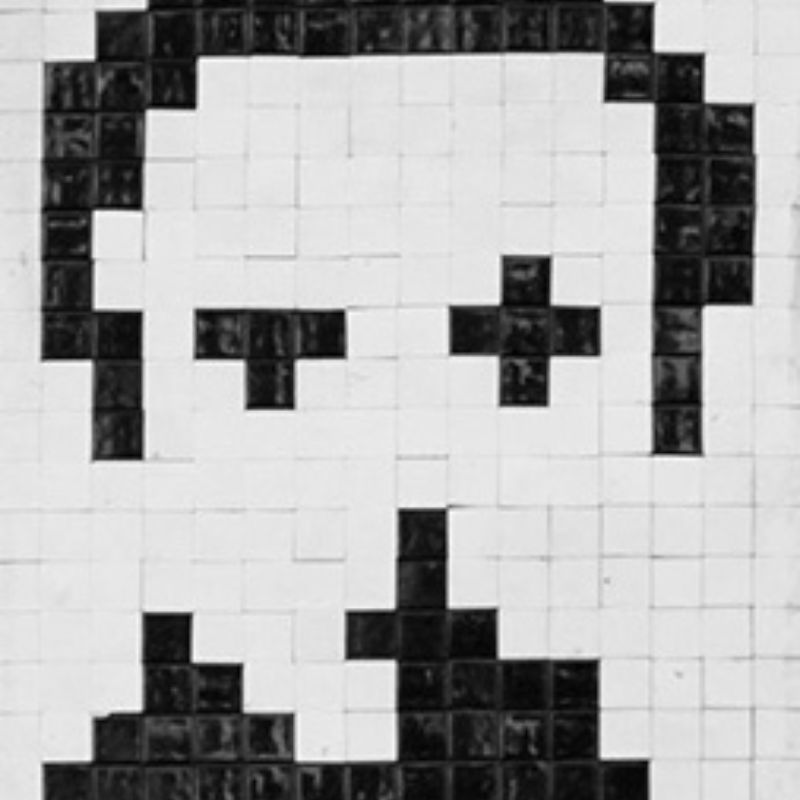
Invader is a world-renowned French contemporary artist whose identity remains a secret. His work, emblematic of urban art, consists of installing mosaics representing pixelated video game characters, mainly inspired by the famous 1970s game «Space Invaders». His artistic project, which he calls «Space Invaders», is a worldwide invasion, a poetic and playful «hacking» of public space.
The origins of the Invasion Project
Born in 1969, Invader grew up in the Paris suburbs. His interest in art and urban culture began early. At the turn of the millennium, in 1998, he launched his artistic project. The idea was simple but ingenious: to recreate the pixelated characters from the «Space Invaders» game in the form of ceramic tile mosaics and to stick them illegally, usually at night, on walls in cities around the world.
This aesthetic choice is not insignificant: the mosaics are reminiscent of Byzantine or Roman art, lending a certain permanence to images from the ephemeral digital world. Pixelation, on the other hand, harks back to the golden age of video games, while at the same time being a universally recognisable visual language.
A Conceptual and Performative Work: Invasion of the Public Space
Invader's work goes far beyond the simple installation of mosaics. It is a multi-faceted conceptual and performative art project:
- The Global Invasion: Each mosaic is considered a «Space Invader» and each installation is recorded and catalogued by the artist. He assigns a number to each piece and updates a «map of invasions» on his website. He has «invaded» more than 80 cities around the world, from Paris to Los Angeles, from Hong Kong to Kathmandu, and even in unusual places like the International Space Station.
- The Score : As in a video game, Invader awards points to each «Invader» according to its size, the difficulty of its location and its visibility. This «score» system invites the public to take part in the game, to «hunt» the Invaders in the city and share their finds.
- Anonymity: Invader's identity is kept strictly secret. He always appears masked during his rare public appearances. This anonymity reinforces the mystery surrounding his character and emphasises that it is the work, and not the artist, that is at the centre of the project.
- Urban intervention : By choosing to intervene in public space without authorisation, Invader questions the notion of ownership, legality and art in the city. His mosaics are often placed in strategic and unexpected locations, on facades, bridges and monuments, transforming the urban landscape into an immense open-air gallery.
Beyond Mosaics: Diversification and Recognition
If mosaics are his signature, Invader has diversified his work:
- Rubikcubism : He creates portraits or entire scenes using Rubik's Cubes, again playing on pixelation and nostalgia.
- «Alias : He has developed three-dimensional sculptures and installations in the same spirit.
- Gallery Exhibitions : Although his main playground is the street, Invader also exhibits in galleries and museums. These exhibitions allow him to present more fragile works, installations or creations that are not intended to be exposed to the elements.
Despite (or thanks to) his status as an illegal artist, Invader has gained worldwide recognition. His works are highly prized on the art market, and he has managed to transform an act of «vandalism» into a highly rated and intellectually stimulating art form.
Heritage
Invader is more than a street artist; he is a subversive urban planner, an archaeologist of the digital age, and a storyteller who scatters the world with small fragments of a collective history. His work is a playful invitation to look at the city differently, to spot art where you least expect it, and to take part in a global game that defies borders and conventions. He continues to invade the world, leaving behind him a joyful, pixelated trace of his passage.
BIOGRAPHY of invader
Invader (born 1969): The Fugitive Artist who Pixelates the World
Invader is a world-renowned French contemporary artist whose identity remains a secret. His work, emblematic of urban art, consists of installing mosaics representing pixelated video game characters, mainly inspired by the famous 1970s game «Space Invaders». His artistic project, which he calls «Space Invaders», is a worldwide invasion, a poetic and playful «hacking» of public space.
The origins of the Invasion Project
Born in 1969, Invader grew up in the Paris suburbs. His interest in art and urban culture began early. At the turn of the millennium, in 1998, he launched his artistic project. The idea was simple but ingenious: to recreate the pixelated characters from the «Space Invaders» game in the form of ceramic tile mosaics and to stick them illegally, usually at night, on walls in cities around the world.
This aesthetic choice is not insignificant: the mosaics are reminiscent of Byzantine or Roman art, lending a certain permanence to images from the ephemeral digital world. Pixelation, on the other hand, harks back to the golden age of video games, while at the same time being a universally recognisable visual language.
A Conceptual and Performative Work: Invasion of the Public Space
Invader's work goes far beyond the simple installation of mosaics. It is a multi-faceted conceptual and performative art project:
- The Global Invasion: Each mosaic is considered a «Space Invader» and each installation is recorded and catalogued by the artist. He assigns a number to each piece and updates a «map of invasions» on his website. He has «invaded» more than 80 cities around the world, from Paris to Los Angeles, from Hong Kong to Kathmandu, and even in unusual places like the International Space Station.
- The Score : As in a video game, Invader awards points to each «Invader» according to its size, the difficulty of its location and its visibility. This «score» system invites the public to take part in the game, to «hunt» the Invaders in the city and share their finds.
- Anonymity: Invader's identity is kept strictly secret. He always appears masked during his rare public appearances. This anonymity reinforces the mystery surrounding his character and emphasises that it is the work, and not the artist, that is at the centre of the project.
- Urban intervention : By choosing to intervene in public space without authorisation, Invader questions the notion of ownership, legality and art in the city. His mosaics are often placed in strategic and unexpected locations, on facades, bridges and monuments, transforming the urban landscape into an immense open-air gallery.
Second World War and Injury (1939-1945) :
- In 1939, he joined the French Foreign Legion.
- After the defeat of France, he was interned in a concentration camp in 1943 because of his German origins.
- He managed to escape and joined the Resistance.
- In 1944, he was seriously wounded in the fighting at Belfort, resulting in the amputation of his right leg. This traumatic experience had a profound impact on his perception of life and art.
Beyond Mosaics: Diversification and Recognition
If mosaics are his signature, Invader has diversified his work:
- Rubikcubism : He creates portraits or entire scenes using Rubik's Cubes, again playing on pixelation and nostalgia.
- «Alias : He has developed three-dimensional sculptures and installations in the same spirit.
- Gallery Exhibitions : Although his main playground is the street, Invader also exhibits in galleries and museums. These exhibitions allow him to present more fragile works, installations or creations that are not intended to be exposed to the elements.
Despite (or thanks to) his status as an illegal artist, Invader has gained worldwide recognition. His works are highly prized on the art market, and he has managed to transform an act of «vandalism» into a highly rated and intellectually stimulating art form.
Heritage
Invader is more than a street artist; he is a subversive urban planner, an archaeologist of the digital age, and a storyteller who scatters the world with small fragments of a collective history. His work is a playful invitation to look at the city differently, to spot art where you least expect it, and to take part in a global game that defies borders and conventions. He continues to invade the world, leaving behind him a joyful, pixelated trace of his passage.
 French
  English