Hans Hartung: Writing silence and movement
Jean Fautrier is a major figure in twentieth-century art, an artist whose work is at once powerful, sombre and of rare emotional intensity. A precursor of informal art and lyrical abstraction, he explored pictorial matter to express the depths of the human condition, particularly in the face of the horror of conflict.
Here are the main points of his biography:
1904: Born in Leipzig, Germany.
From an early age, Hartung showed a keen interest in art. He was fascinated by lightning, storms and natural phenomena, which he tried to transcribe in his first drawings. Very early on, he developed a sensitivity to the spontaneity of line.
Training and First Contacts with Abstraction (1920s) :
- He studied philosophy and art history at the universities of Leipzig and Dresden.
- He attended the art academies in Leipzig and Dresden.
- He discovered the works of Kandinsky, Kokoschka, Nolde and Rembrandt.
- From 1922, he began to paint entirely abstract canvases, with no reference to visible reality, anticipating many developments in abstract art. These works are characterised by lines, patches and free compositions. - Moving to France (1930s) :
- He moved to Paris in 1932, fleeing the rise of Nazism in Germany, which rejected his art as «degenerate».
- There he met artists such as Mondrian, Miró, Calder and Kandinsky, and became friends with Henri Goetz, who offered him a studio.
- Despite difficult living conditions and a lack of recognition, he continued to explore his abstract language, characterised by fluid geometric forms and dynamic compositions.
Second World War and Injury (1939-1945) :
- In 1939, he joined the French Foreign Legion.
- After the defeat of France, he was interned in a concentration camp in 1943 because of his German origins.
- He managed to escape and joined the Resistance.
- In 1944, he was seriously wounded in the fighting at Belfort, resulting in the amputation of his right leg. This traumatic experience had a profound impact on his perception of life and art.
French naturalisation and recognition (post-war period) :
- In 1946, he obtained French nationality.
- The post-war years marked the beginning of his recognition. He took part in numerous exhibitions in France and abroad.
- His work is associated with’lyrical abstraction and the’informal art, These are movements that emphasise spontaneous expression, gesture and the artist's subjectivity, as opposed to geometric abstraction.
- His works are characterised by calligraphic signs, bundles of energetic strokes, scratches and rubbing, reflecting great freedom of movement and emotional intensity.
Periods of Creation and Evolution of Style :
- 1950s: This period is emblematic of «spots and scratches», where black, incisive strokes unfold on coloured backgrounds. The gesture is rapid and direct.
- 1960s: He experiments with new tools and techniques (wide brushes, rollers, spraying) to create vibrant splashes of colour and clusters of lines that seem to spring from the canvas.
- 1970s and 1980s: Despite health problems that forced him to paint from his wheelchair, he never stopped innovating. He uses scrapers
spray guns and blowpipes to create bands of light, clouds of colour and streaks of light. Gesture remained essential, even if it was sometimes mediated by tools. His palette became clearer and more luminous towards the end of his life.
- Awards and distinctions :
- In 1960, he was awarded the Grand Prix International de Peinture at the Venice Biennale, confirming his stature as a major artist.
1989: Death in Antibes, France.
He left behind a monumental body of work that left a lasting mark on the history of abstract art.
Hans Hartung's work is a constant exploration of line, gesture, colour and light. He sought to make the invisible visible, to express inner emotions and movements of the soul through compositions of great vitality and undeniable expressive power. He remains an emblematic figure of creative freedom and artistic perseverance in the face of life's trials.
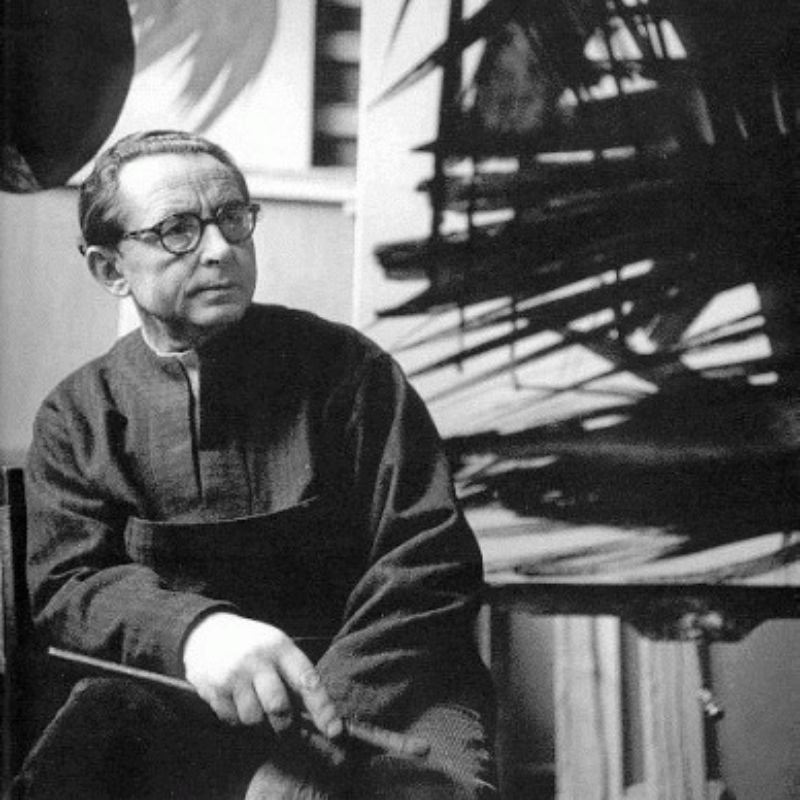
Hans Hartung: Writing silence and movement
Hans Hartung was a French painter of German origin and a major figure in lyrical abstraction and informal art. His life and work are marked by the turbulence of the 20th century and a constant quest for freedom and gestural expression.
Here are the main points of his biography:
1904: Born in Leipzig, Germany.
From an early age, Hartung showed a keen interest in art. He was fascinated by lightning, storms and natural phenomena, which he tried to transcribe in his first drawings. Very early on, he developed a sensitivity to the spontaneity of line.
Training and First Contacts with Abstraction (1920s) :
- He studied philosophy and art history at the universities of Leipzig and Dresden.
- He attended the art academies in Leipzig and Dresden.
- He discovered the works of Kandinsky, Kokoschka, Nolde and Rembrandt.
- From 1922, he began to paint entirely abstract canvases, with no reference to visible reality, anticipating many developments in abstract art. These works are characterised by lines, patches and free compositions. - Moving to France (1930s) :
- He moved to Paris in 1932, fleeing the rise of Nazism in Germany, which rejected his art as «degenerate».
- There he met artists such as Mondrian, Miró, Calder and Kandinsky, and became friends with Henri Goetz, who offered him a studio.
- Despite difficult living conditions and a lack of recognition, he continued to explore his abstract language, characterised by fluid geometric forms and dynamic compositions.
Second World War and Injury (1939-1945) :
- In 1939, he joined the French Foreign Legion.
- After the defeat of France, he was interned in a concentration camp in 1943 because of his German origins.
- He managed to escape and joined the Resistance.
- In 1944, he was seriously wounded in the fighting at Belfort, resulting in the amputation of his right leg. This traumatic experience had a profound impact on his perception of life and art.
French naturalisation and recognition (post-war period) :
- In 1946, he obtained French nationality.
- The post-war years marked the beginning of his recognition. He took part in numerous exhibitions in France and abroad.
- His work is associated with’lyrical abstraction and the’informal art, These are movements that emphasise spontaneous expression, gesture and the artist's subjectivity, as opposed to geometric abstraction.
- His works are characterised by calligraphic signs, bundles of energetic strokes, scratches and rubbing, reflecting great freedom of movement and emotional intensity.
Periods of Creation and Evolution of Style :
- 1950s: This period is emblematic of «spots and scratches», where black, incisive strokes unfold on coloured backgrounds. The gesture is rapid and direct.
- 1960s: He experiments with new tools and techniques (wide brushes, rollers, spraying) to create vibrant splashes of colour and clusters of lines that seem to spring from the canvas.
- 1970s and 1980s: Despite health problems that forced him to paint from his wheelchair, he never stopped innovating. He uses scrapers
spray guns and blowpipes to create bands of light, clouds of colour and streaks of light. Gesture remained essential, even if it was sometimes mediated by tools. His palette became clearer and more luminous towards the end of his life.
Awards and distinctions :
In 1960, he was awarded the Grand Prix International de Peinture at the Venice Biennale, confirming his stature as a major artist.
1989: Death in Antibes, France.
He left behind a monumental body of work that left a lasting mark on the history of abstract art.
Hans Hartung's work is a constant exploration of line, gesture, colour and light. He sought to make the invisible visible, to express inner emotions and movements of the soul through compositions of great vitality and undeniable expressive power. He remains an emblematic figure of creative freedom and artistic perseverance in the face of life's trials.
 French
  English