
Erró (born Guðmundur Guðmundsson in 1932): The Maestro of Global Collage and Narrative Painting
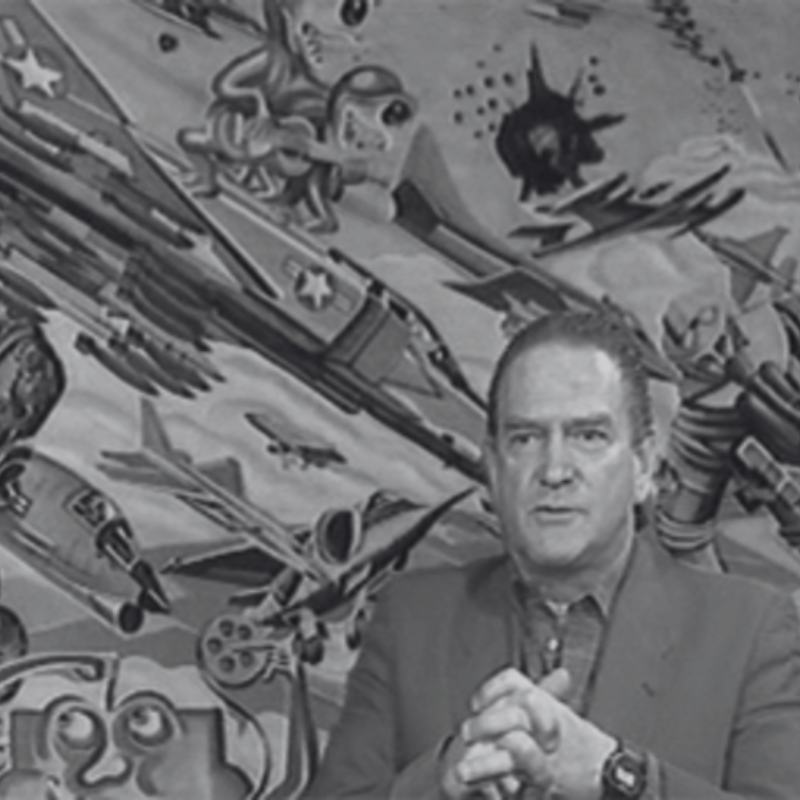
Erró is an internationally renowned Icelandic artist and a major figure in Pop Art and Narrative Figuration. His prolific body of work is a visual kaleidoscope of comic strip images, news photographs, advertisements, popular culture icons and historical references, all arranged in complex and often surreal compositions. He is a veritable «image plunderer» who has created a unique and recognisable pictorial language.
International Training and First Steps in Art
Born in 1932 in Ólafsvík, Iceland, Guðmundur Guðmundsson was attracted to art from an early age. He studied at the Academy of Fine Arts in Reykjavik, then continued his training in Norway and Italy, notably at the Academy of Fine Arts in Florence. These years of travel and study (he also took an interest in mosaics, ceramics and architecture) considerably broadened his artistic horizons and fuelled his insatiable curiosity for images.
In the 1950s, he moved to Paris, which became his main place of residence and work. It was here that he adopted the pseudonym Erró, which means «error» or «wanderer» in Latin, a name that reflects his free spirit and iconoclastic approach.
The click of collage and the birth of his style
From the late 1950s and early 1960s, Erró developed a singular working method, inspired by Dadaism and Surrealism, but renewed by the advent of mass media. He built up an immense «reservoir» of images gleaned from newspapers, magazines, comic strips, catalogues and advertising posters. He cut up, collected and classified these images, which he then used to create collages in preparation for his paintings.
His paintings are therefore not spontaneous creations, but meticulously enlarged reproductions of these collages. This technique enables him to juxtapose disparate elements, create visual and narrative shocks, and comment, often with humour and irony, on the contemporary world.
Major Themes and Emblematic Series
Erró's work is organised into major thematic series, allowing him to explore different facets of society and history:
- Mecanismo« or »Chinese Scenes« series» (1960s): Erró incorporates characters from American comic strips into Chinese landscapes or scenes of Maoist propaganda, creating an absurd, hard-hitting dialogue between East and West.
- Foodscapes« series Famous people (often figures from the history of art) are swallowed up or transformed by mountains of food, a colourful critique of consumer society.
- Cosmos« and »Space« series» The author explores the themes of science fiction and the conquest of space, often with a touch of black humour.
- Text Table« series» Paintings in which text and image respond to each other, blurring the lines between reading and seeing.
- Landscape« series» Always collages of images of nature or architecture to create fantastic panoramas.
• Self-portraits« series» Erró puts himself on stage, sometimes transformed or surrounded by his own images.
Characteristic Style
Erró's style is instantly recognisable:
- A palette of bright, vibrant colours, typical of Pop Art.
- The precision of his line, Despite the complexity of the compositions, every detail is reproduced with almost photographic clarity.
- The density of his paintings, Every square centimetre is saturated with images, creating a visual explosion.
- His sense of humour and derision, which is often apparent in the unexpected juxtapositions and diversions.
Recognition and Legacy
Erró has exhibited all over the world and his work can be found in the collections of the greatest international museums. He is a tireless traveller and a compulsive collector of images, which constantly feeds his creativity. His work is a reflection on the proliferation of images in our societies, their power to manipulate, but also their capacity to construct new realities.
Through his art, Erró invites us to decode the incessant flood of visual information that surrounds us, to question the myths of our time and to savour the sometimes poetic absurdity of the world. He remains a major figure in contemporary art, whose relevance continues to be confirmed.
BIOGRAPHY of Jean Fautrier
Jean Fautrier (1898 - 1964): The Pioneer of the Informal and the Painter of the Tragic Human
Jean Fautrier is a major figure in twentieth-century art, an artist whose work is at once powerful, sombre and of rare emotional intensity. A precursor of informal art and lyrical abstraction, he explored pictorial matter to express the depths of the human condition, particularly in the face of the horror of conflict.
A Youth Marked by Drama and Independence
Born in Paris in 1898, Jean Fautrier had a difficult childhood. His father died when he was very young, and he was brought up by his mother and grandmother. At the age of 15, he moved to London, where he attended the Royal Academy of Arts and the Slade School of Fine Art, but soon left these institutions, preferring a self-taught education. His independence of spirit and his desire not to submit to any particular school or movement were to mark his entire career.
Returning to France after the First World War, he settled in Paris and began exhibiting in the 1920s. His works from this period were often figurative, depicting dark landscapes, tortured bodies and melancholy still lifes, with a strong preoccupation with matter and texture. He developed a technique in which the paste was generous, worked with a knife, creating striking reliefs and luminous effects.
Artface and the Hostages: Witness to Horror
The Second World War marked a decisive and tragic turning point in Fautrier's work. As a refugee in the Vallée de la Chevreuse, near Châtenay-Malabry, he witnessed the atrocities committed by the German occupiers, in particular the executions of hostages in the nearby forest. Deeply moved by these events, he produced his most famous and poignant series between 1943 and 1945: «The Hostages».
In this series, Fautrier moved away from recognisable figuration to achieve a form of expressive and tragic abstraction. The «Hostages» are anonymous heads, disfigured by suffering, fashioned in a thick, almost carnal paste, with reliefs that evoke lacerated flesh and eyes wide with horror. The colours are pale, greyish, sometimes enhanced by touches of blood red or sickly yellow. Although not directly representative, these works manage to communicate an existential anguish and universal pain. They are a powerful testimony to the unspeakable and are considered to be essential precursors of informal art and tachism.
A Pioneer of Informal Art
After the war, Fautrier continued to explore the possibilities of pictorial matter. He was recognised as one of the pioneers of informal art, a movement that rejected geometry and defined forms in favour of the spontaneity of gesture and the expressiveness of the material. He developed mixed techniques, using impastos of plaster, glue, powders and pigments to create rich, vibrant textures. His works, often composed in series («Hauts reliefs», «Objets», «Partis pris», «Nus», «Portes»), tackle a variety of themes with the same emotional depth.
Recognition and Legacy
Although sometimes controversial and for a long time solitary in his approach, Jean Fautrier has gradually gained international recognition. He is represented in the major
collections and museums around the world. In 1960, he was awarded the Grand Prix International de Peinture at the Venice Biennale, confirming his status as a major artist.
Jean Fautrier died in 1964 in Châtenay-Malabry. His work remains a radical exploration of matter and emotion. He invites us to look beyond appearances, to plumb the depths of the human soul and confront the beauty and terror of the world with a rare authenticity. His influence on the generations of artists who followed him is undeniable, making him an essential figure in the history of modern art.
 French
  English